



Why your AI agent forgets everything (and what to do about it)
AI coding agents are powerful but stateless. Every new session starts from zero. Here's why that happens and how a persistent memory layer fixes it.

Open a fresh chat with your coding agent and watch what happens. It doesn't know which database you're using. It can't remember why you rejected that architecture last week. It re-asks questions you already answered. Every session, you pay a context tax: ten minutes of re-explaining things that should already be known.
This isn't a flaw in any particular model. It's structural. Large language models are stateless - each conversation is a clean slate, and once the context window closes, everything in it is gone. The agent that felt like a brilliant collaborator yesterday has total amnesia today.
Context windows are not memory
It's tempting to think a bigger context window solves this. It doesn't. A context window is working memory - what the agent can see right now. Memory is what persists when the window closes. Stuffing more into the window is expensive, gets truncated, and still vanishes the moment the session ends. What you actually want is for decisions and constraints to outlive any single conversation.
What persistent memory looks like
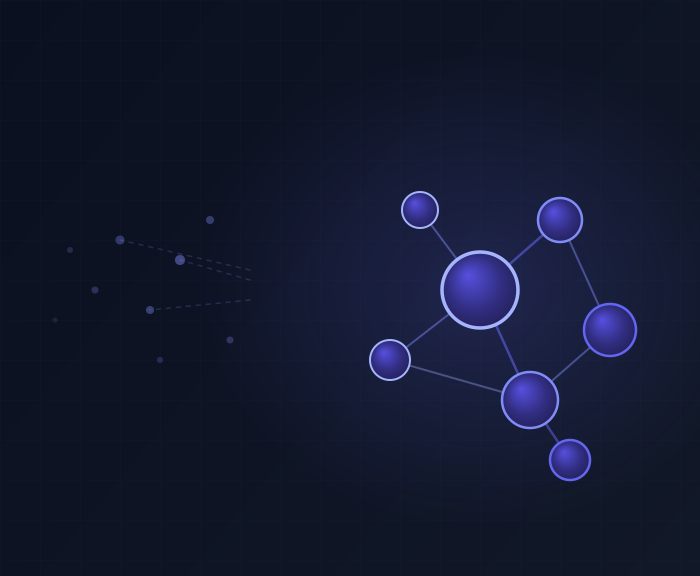
Recordari is a memory layer your agent writes to as it works. When it makes a decision - "we're using PostgreSQL, because all our migrations and query patterns depend on it" - it files that as a memory. Memories connect to each other, forming a knowledge graph of how your project actually fits together.
Next session, the agent orients on the project domain and everything is waiting: recent decisions, known constraints, the threads left open last time. No re-explaining. The agent picks up where it left off.
Why the audit trail matters
Persistent memory isn't only about convenience. As agents run more autonomously and make decisions on your behalf, you need to know exactly what was read, what was written, and when. Recordari logs every operation - queryable and exportable - so the memory layer doubles as an accountability layer.
Getting started
Connecting takes a few minutes with any MCP-compatible client. See the getting started guide, or read the full documentation.